10 Best AI Chatbot Solutions for Web & Mobile Apps in 2026
 Published On February 24th, 2026
AI chatbots so far have achieved a long way. They’re more than just simple automation tools. They are smart, context-aware, and behind a lot of the web and mobile experiences we see today.
The market size for AI chatbots is set to cross $20 billion by 2026 as more and more enterprises are adopting these for customer interaction, cost savings, and control over data. For entrepreneurs and developers, knowing about AI chatbots and how assessment of chatbot platforms and the benefits of custom development are done is critical.
That’s why, to find you the best AI Chatbot Solution for Web & Mobile Apps in 2026, this article is here to help you out.
Table of Contents
What Is an AI Chatbot
An AI chatbot is not an ordinary automated tool. It is a system that is based on natural language processing, machine learning, and large language models. It tries to understand not only what users are saying but also why users are saying it.
Such chatbots do not simply deliver pre-recorded answers. They follow along, answer fast, and learn to match users’ style, across the website or messaging on your phone.
Now, when it comes to traditional chatbots, they usually depend on rigid rules, simple scripts, or just matching keywords. As a result, the system doesn’t get the conversation if you go off the plan.
In fact, AI-powered chatbots utilize large language models and Natural Language Processing. They’re used for participating in open-ended conversations, just answering, and assisting with problems.
How Does a Custom AI Chatbot Work?
There is a custom AI chatbot that runs on a system with multiple layers. These different layers address different tasks. They ensure that the system remains flexible and easy to manage.
- Model Layer (LLMs): The first layer is the one with large language models. This layer is responsible for understanding user intent, getting the context, and also generating natural, human-like responses in real time.
- Orchestration Layer: It keeps the conversation flowing, handles business logic, and knows when to trigger workflows, ping APIs, or hand things over to a human agent when needed.
- Data and Memory Layer: This layer keeps the records of the conversation, user context, embeddings, and the knowledge base data to allow personalization and consistent multi-turn interactions.
- Channel Layer (Web, iOS, Android): This channel layer connects the chatbot with any front-end platforms in order to make the conversations consistent among web and mobile applications.
In sum, these layers enable businesses to develop customized chatbots using AI for complex situations and integrate them with any system they require, wherever they need them.
How We Evaluated the Best AI Chatbot Solutions for 2026
In order to rank the highest AI chatbot platforms for 2026, we put the main focus on their technical flexibility, options for deployment, and suitability for the use of web and mobile in the long run.
- Supported Platforms (Web, iOS, Android) – We checked if each platform could launch chatbots across different devices of web, iOS, and Android, all while delivering continuous and flawless features and performance.
- AI and LLM Flexibility – Platforms were evaluated on their ability to integrate with multiple large language models rather than enforcing dependency on a single AI provider.
- SDKs and Developer Friendliness – We dove into their SDKs, APIs, documentation, and development tools. It is basically anything that makes life easier for developers building and integrating chatbots.
- Hosting and Deployment Models – Solutions were compared based on support for cloud, on-premises, and hybrid deployments to meet enterprise infrastructure requirements.
- Customization and White Label Support – We examined how deeply platforms allow customization of chatbot logic, UI, workflows, and branding.
- Security and Compliance Capabilities – Security features such as encryption, access control, and compliance readiness for regulated industries were key evaluation factors.
- Scalability and Performance – We assessed how well each platform handles high traffic, concurrent users, and real-time responses without degradation in performance.
- Pricing Transparency and Long-Term Cost – Different pricing models have been examined by people to make sure that the costs are clear, scalable, and most importantly, predictable.
What Are the Benefits of Using a Custom AI Chatbot?
Custom AI chatbots are simple to manage and have a high degree of flexibility, with results that are beyond the capabilities of general AI chatbots.
1. Data Ownership
- Custom chatbots give their users their own control over data, training data, and infrastructure for storing data.
2. Cloud & On-Premises Deployment Flexibility
- There are deployment models that businesses can select according to their security, compliance, and business requirements.
3. Cost Control at Scale
- The costs for a self-hosted or custom deployment scenario can be predicted, and one can avoid the continuous increase in usage, based on SaaS pricing.
4. Vendor Lock-In Avoidance
- Build on a model-agnostic architecture, and you’re free to switch AI models or providers whenever you want. Your options stay open.
5. Latency and Performance
- Custom deployments deliver faster response times, crucial when users expect answers right away.
6. Compliance Readiness
- Custom AI chatbots can be set up in a way as to comply with any regulatory requirements and data protection rules in different industries and regions.
Top 10 AI Chatbot Software Solutions for Web and Mobile Apps
Here are the Top 10 AI chatbot software solutions for web and mobile apps, Apphitect, MirrorFly, zapier, Botpress, kore.ai, Ada, Tidio, Freshchat (Freshworks), Yellow AI, and Haptik.
1. Apphitect Chatbot Solution
Top Enterprise AI Chatbot for Full Customization
Apphitect provides a framework that can be tailored to suit the needs of AI, based conversational agents, and instant messaging applications. The company impresses with the developer’s freedom, modular integrations, and scalability of deployment for both enterprises and startups.
Apphitect Chatbot Features
- Fully customizable AI chatbot architecture
- Seamless Live Agent Handoff
- Complete data ownership
- Full source code access
- Built-in sentiment analysis
- Generative AI Capabilities
- Conversation history management
- Retrieval Augmented Generation (RAG) support
- Lead qualification & CRM integration
- Drag-and-Drop Editor
- Task & workflow automation
- Model-agnostic LLM integration
- AI Agent Evaluation Scorecards
- Compliance with Enterprise-grade security (GDPR + HIPAA)
- No Third-Party Data Training / Retention
Use Case Example
AI voice agents handle customer support, appointment scheduling, order tracking, and intelligent call routing to streamline voice interactions.
Supported Platforms and SDKs
Appitect AI chatbot solution targets Android and iOS, web platforms including JavaScript, React, Angular, and Vue, cross-platform development tools including Flutter and React Native, backend support through REST API and webhook integration. It plays well with model-agnostic LLMs such as GPT, Claude, Gemini, and Llama.
Deployment Model
The solution can be deployed as a self, hosted on, premises solution, on a private cloud, or in a hybrid mode, thus allowing enterprises to align with their infrastructure requirements.
Limitations
Knowledge base auto-sync and LLM testing features are currently in beta and may require additional configuration.
Ideal Use Cases
Enterprises that need branded voice automation solutions, call centers, business sectors that must abide by rules and regulations, and large-scale operations involving voices.
2. MirrorFly AI Chatbot Solution
AI Chatbot Platform for Web & Mobile Apps
MirrorFly AI chatbot solution enables organizations to build low-latency, fully controllable voice agents for real-time conversations. It combines NLP, ML, and speech technologies with secure, flexible deployments and deep system integrations.
MirrorFly AI Chatbot Features
- Customizable AI Chatbot
- No Third-Party Data Training / Retention
- Data Ingestion
- Complete Data Ownership & Sovereignty
- Full Source Code Access
- Lead Qualification & CRM Integration
- Sentiment Analysis
- Knowledge Base Integration
- No-Code Builder / Drag-and-Drop Editor
- Conversation History & Context Management
- Retrieval Augmented Generation
- Large Language Model (LLM) Integration
- Human Handoff
- Task Automation
- Security & Advanced Compliance (GDPR+HIPAA)
Use Case Example
AI voice agents support customer service, appointment booking, order tracking, and intelligent call routing to streamline voice interactions.
Supported Platforms & SDKs
The solution is compatible with Android and IOS. It also supports web frameworks, including JavaScript, React, Angular, and Vue, and cross-platform frameworks, including Flutter, React Native, backend APIs, and webhooks. The model, agnostic AI integrations consist of GPT, Claude, Gemini, and Llama.
Deployment Model
It is self-hosted and obtainable on a local server, private cloud, or in a hybrid manner.
Limitations
Knowledge base auto-sync and LLM testing features are currently in beta.
Ideal Use Cases
Enterprises that need branded voice automation, contact centers, regulated businesses, and high-volume voice.
3. Zapier No-Code AI Chatbot
Best No-Code AI Chatbot Automation Tool
Zapier By establishing connections between conversational interfaces and business applications, Zapier allows AI-powered chatbot automation to be realized with the aid of no-code workflows.
Zapier Chatbot Features
- No-code automation builder
- AI-assisted workflow logic
- 6,000+ app integrations
- Event-based triggers and actions
- Webhook and API support
- Conditional automation paths
- CRM and support tool connectivity
- Scalable multi-step workflows
Use Case Example
Automating lead capture, ticket creation, and follow-up actions triggered from chatbot conversations.
Supported Platforms and SDKs
Web-based dashboard, REST API, and webhooks can be used for the integration of a system with communication channels like Slack, WhatsApp, or CRM.
Deployment Model
Completely cloud-based SaaS solution, managed through Zapier.
Limitations
Conversational depth depends on external chatbot platforms.
Ideal Use Cases
Teams seeking to automate chatbot-driven workflows, which involve interaction with business apps via chat, can benefit from this solution, while manual operational tasks will be reduced.
4. Botpress
Top Open-Source AI Chatbot Framework
Botpress is a developer-friendly platform offering the construction of sophisticated AI-powered chatbots with maximum functionality and control over logic and data.
Botpress Chatbot Features
- Open-source core framework
- LLM-powered conversations
- Visual flow and dialog builder
- Custom scripting and logic
- Retrieval Augmented Generation (RAG)
- Multilingual chatbot support
- API-first extensibility
- Enterprise-grade security options
Use Case Example
Custom AI assistants for customer support, internal tools, and knowledge-based chat systems.
Supported Platforms and SDKs
Web chat interfaces, Node.js SDK, REST APIs, and integrations with messaging and collaboration platforms.
Deployment Model
The product can be self-hosted on premises, private cloud, or managed cloud deployment.
Limitations
Setup and optimization require developer expertise.
Ideal Use Cases
Developers and technology groups are working on customized AI chatbots for which the entire environment and control can be achieved.
5. Kore.ai AI Chatbot Platform
Leading Enterprise AI Chatbot Platform
Enterprise-level Kora.ai is a conversational AI technology platform of chatbots and voice bots that provides scalable, secure, and standardized deployments.
Kore.ai Chatbot Features
- Conversational AI engine
- Prebuilt industry-specific bots
- Advanced NLU and dialog orchestration
- Chat and voice AI support
- LLM integration and orchestration
- Analytics and performance monitoring
- Human agent escalation
- Security and compliance controls
Use Case Example
Customer support automation, IT service bots, and enterprise voice assistants.
Supported Platforms and SDKs
You get broad support: web, iOS, Android, voice channels, enterprise SDKs, REST APIs, and integration with existing systems.
Deployment Model
Public, private, on-premises, or hybrid enterprise deployment.
Limitations
The costs of pricing and the complexity of the platform might be high in the case of smaller teams.
Ideal Use Cases
Organizations that require secure and scalable conversational AI to power their customer support, IT helpdesk, and internal automation.
6. Ada AI Chatbot
Best AI Chatbot for Customer Support Automation
Ada takes a different approach. It’s a no-code AI chatbot platform for automating consumer support, so teams can launch new bots quickly without steep technical overhead.
Ada Chatbot Features
- No-code chatbot builder
- AI-trained support automation
- Multi-language conversation support
- CRM and helpdesk integrations
- Context-aware responses
- Analytics and reporting
- Live agent handoff
- Brand customization tools
Use Case Example
E-commerce and SaaS automated customer service solutions.
Supported Platforms and SDKs
Web widgets, Shopify and WordPress plugins, Messenger, email integrations, and rudimentary APIs.
Deployment Model
Cloud-hosted SaaS managed by Ada.
Limitations
Limited backend customization for complex workflows.
Ideal Use Cases
Businesses aiming to automate customer support with minimal technical setup and fast chatbot deployment.
7. Tidio AI Chatbot
Best AI Chatbot for Small Businesses
Tidio gives user the access to AI-powered chatbots and live chat functionalities that are built for immediate use in small and medium-sized enterprises.
Tidio Chatbot Features
- AI chatbot & live chat combo
- Prebuilt automation flows
- E-commerce platform integrations
- Visitor behavior tracking
- Email & Messenger support
- Simple chatbot editor
- Analytics dashboard
- Quick setup & onboarding
Use Case Example
Lead generation and customer support automation for e-commerce stores.
Supported Platforms and SDKs
Web widgets, Shopify and WordPress plugins, Messenger, email integrations, and basic APIs.
Deployment Model
Cloud, based SaaS platform.
Limitations
Not appropriate for chatbot implementations of enterprise scale, or those that require a high degree of customization.
Ideal Use Cases
Small and mid, sized businesses looking for a rapid chatbot setup to generate leads and provide basic customer support.
8. Freshchat (Freshworks) Omnichannel AI Chatbot
Top Omnichannel AI Chatbot for Customer Messaging
Freshchat is a customer messaging and AI chatbot software particularly made and designed for support, sales, and in-app engagement.
Freshchat Chatbot Key Features
- Omnichannel messaging
- CRM and ticketing integration
- Automated workflows
- Analytics and reporting
Use Case Example
In-app customer support and lead engagement services for the SaaS and E-commerce industries.
Supported Platforms and SDKs
It runs on web, Android, iOS, and offers in-app SDKs, REST APIs, and deep Freshworks integrations.
Deployment Model
Cloud, based SaaS platform.
Limitations
Outside the Freshworks ecosystem, there is only a limited amount of customization.
Ideal Use Cases
works best when you want in-app messaging, automation for support, and a CRM-connected chat, all in one place.
9. Yellow.ai AI Chatbot
Best Multilingual AI Chatbot for Enterprises
Yellow.ai is an enterprise-level conversational AI platform supporting advanced chat and voice automation at scale.
Yellow.ai Chatbot Key Features
- Multilingual conversational AI
- Chat and voice bot support
- LLM-powered dialog management
- Enterprise analytics
- Human agent handoff
Use Case Example
Customer service automation in different fields, including voice and digital channels for large enterprises.
Supported Platforms and SDKs
Web, mobile apps, voice channels, messaging platforms, APIs, and enterprise integrations.
Deployment Model
Runs in the cloud first, but you can also go private cloud, on-premises, or use a hybrid setup.
Limitations
Platform complexity may require dedicated AI or IT teams.
Ideal Use Cases
The perfect application for a multilingual omnichannel automation solution will be customer support, sales, and service in the case of enterprise companies.
10. Haptik AI Chatbot
Top-rated AI Chatbot for Telecom
Haptik is a conversational AI company that mainly caters to customers’ communication needs by providing support and performing transactions.
Haptik Chatbot Key Features
- AI chat and voice bots
- Prebuilt industry templates
- Multilingual NLP support
- CRM and backend integrations
- Analytics and optimization tools
Use Case Example
Customer support and transaction automation in telecom, BFSI, and e-commerce sectors.
Supported Platforms and SDKs
Web, Android, iOS, WhatsApp, voice channels, APIs, and enterprise system integrations.
Deployment Model
Cloud-hosted with enterprise deployment options.
Limitations
Customization depth may vary across industry-specific templates.
Ideal Use Cases
Enterprises in the BFSI, telecom, and e-commerce sectors are seeking conversational AI to manage a large volume of customer interactions and transactions.
Common Mistakes to Avoid When Choosing an AI Chatbot Platform
Finding an appropriate AI chatbot solution begins by understanding the capabilities of the technology and aligning them with the actual needs of your business.
- Focusing Only on Short-Term Features – Selecting a platform based only on current features can restrict future expansion as chatbot requirements evolve.
- Chasing Only Short-Term Features – Simply using features of the present to make a choice of platform will not allow you to extend your chatbot capabilities, as they will continue to evolve.
- Underestimating Integration Complexity – Restricted SDKs and APIs usually result in longer times to implement them.
- Ignoring Long-term Costs – Usage-based pricing models can appear attractive in terms of cost at first but can prove pricey down the line.
- Not Assessing AI Flexibility – Platforms tied to a single LLM reduce the ability to optimize performance or adopt newer models.
How to Choose the Right AI Chatbot Solution for Your Business
Start by lining up what the technology offers with what your business actually needs. Clarity here saves a lot of pain later.
Define Your Use Case Clearly: Specify the chatbot’s use case across customer support, sales, or internal automation prior to shopping platforms.
Assess Deployment and Security Requirements: Make sure the solution matches your infrastructure, compliance rules, and data governance needs. Don’t try to force a square peg into a round hole.
Achieve Flexibility and Scalability: By supporting changeable processes and user growth, the platforms you seek should be able to continue operations without interruption.
Evaluate Developer Experience: Good SDKs, documentation, and support make development and maintenance easier.

AI chatbots so far have achieved a long way. They’re more than just simple automation tools. They are smart, context-aware, and behind a lot of the web and mobile experiences we see today.
The market size for AI chatbots is set to cross $20 billion by 2026 as more and more enterprises are adopting these for customer interaction, cost savings, and control over data. For entrepreneurs and developers, knowing about AI chatbots and how assessment of chatbot platforms and the benefits of custom development are done is critical.
That’s why, to find you the best AI Chatbot Solution for Web & Mobile Apps in 2026, this article is here to help you out.
Table of Contents
What Is an AI Chatbot
An AI chatbot is not an ordinary automated tool. It is a system that is based on natural language processing, machine learning, and large language models. It tries to understand not only what users are saying but also why users are saying it.
Such chatbots do not simply deliver pre-recorded answers. They follow along, answer fast, and learn to match users’ style, across the website or messaging on your phone.
Now, when it comes to traditional chatbots, they usually depend on rigid rules, simple scripts, or just matching keywords. As a result, the system doesn’t get the conversation if you go off the plan.
In fact, AI-powered chatbots utilize large language models and Natural Language Processing. They’re used for participating in open-ended conversations, just answering, and assisting with problems.
How Does a Custom AI Chatbot Work?
There is a custom AI chatbot that runs on a system with multiple layers. These different layers address different tasks. They ensure that the system remains flexible and easy to manage.
- Model Layer (LLMs): The first layer is the one with large language models. This layer is responsible for understanding user intent, getting the context, and also generating natural, human-like responses in real time.
- Orchestration Layer: It keeps the conversation flowing, handles business logic, and knows when to trigger workflows, ping APIs, or hand things over to a human agent when needed.
- Data and Memory Layer: This layer keeps the records of the conversation, user context, embeddings, and the knowledge base data to allow personalization and consistent multi-turn interactions.
- Channel Layer (Web, iOS, Android): This channel layer connects the chatbot with any front-end platforms in order to make the conversations consistent among web and mobile applications.
In sum, these layers enable businesses to develop customized chatbots using AI for complex situations and integrate them with any system they require, wherever they need them.
How We Evaluated the Best AI Chatbot Solutions for 2026
In order to rank the highest AI chatbot platforms for 2026, we put the main focus on their technical flexibility, options for deployment, and suitability for the use of web and mobile in the long run.
- Supported Platforms (Web, iOS, Android) – We checked if each platform could launch chatbots across different devices of web, iOS, and Android, all while delivering continuous and flawless features and performance.
- AI and LLM Flexibility – Platforms were evaluated on their ability to integrate with multiple large language models rather than enforcing dependency on a single AI provider.
- SDKs and Developer Friendliness – We dove into their SDKs, APIs, documentation, and development tools. It is basically anything that makes life easier for developers building and integrating chatbots.
- Hosting and Deployment Models – Solutions were compared based on support for cloud, on-premises, and hybrid deployments to meet enterprise infrastructure requirements.
- Customization and White Label Support – We examined how deeply platforms allow customization of chatbot logic, UI, workflows, and branding.
- Security and Compliance Capabilities – Security features such as encryption, access control, and compliance readiness for regulated industries were key evaluation factors.
- Scalability and Performance – We assessed how well each platform handles high traffic, concurrent users, and real-time responses without degradation in performance.
- Pricing Transparency and Long-Term Cost – Different pricing models have been examined by people to make sure that the costs are clear, scalable, and most importantly, predictable.
What Are the Benefits of Using a Custom AI Chatbot?
Custom AI chatbots are simple to manage and have a high degree of flexibility, with results that are beyond the capabilities of general AI chatbots.
1. Data Ownership
- Custom chatbots give their users their own control over data, training data, and infrastructure for storing data.
2. Cloud & On-Premises Deployment Flexibility
- There are deployment models that businesses can select according to their security, compliance, and business requirements.
3. Cost Control at Scale
- The costs for a self-hosted or custom deployment scenario can be predicted, and one can avoid the continuous increase in usage, based on SaaS pricing.
4. Vendor Lock-In Avoidance
- Build on a model-agnostic architecture, and you’re free to switch AI models or providers whenever you want. Your options stay open.
5. Latency and Performance
- Custom deployments deliver faster response times, crucial when users expect answers right away.
6. Compliance Readiness
- Custom AI chatbots can be set up in a way as to comply with any regulatory requirements and data protection rules in different industries and regions.
Top 10 AI Chatbot Software Solutions for Web and Mobile Apps
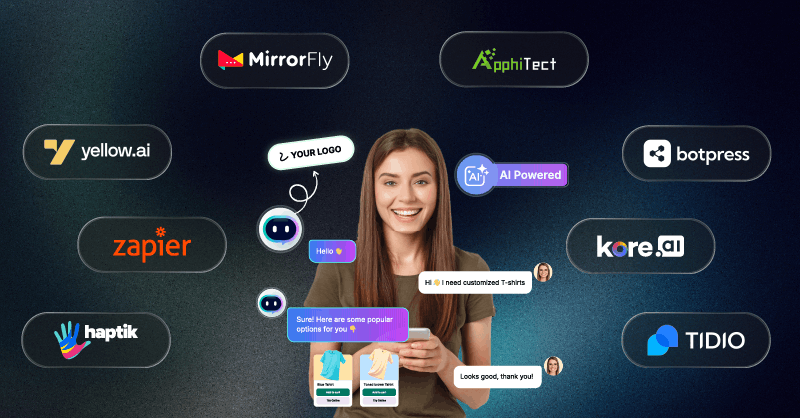
Here are the Top 10 AI chatbot software solutions for web and mobile apps, Apphitect, MirrorFly, zapier, Botpress, kore.ai, Ada, Tidio, Freshchat (Freshworks), Yellow AI, and Haptik.
1. Apphitect Chatbot Solution
Top Enterprise AI Chatbot for Full Customization
Apphitect provides a framework that can be tailored to suit the needs of AI, based conversational agents, and instant messaging applications. The company impresses with the developer’s freedom, modular integrations, and scalability of deployment for both enterprises and startups.
Apphitect Chatbot Features
- Fully customizable AI chatbot architecture
- Seamless Live Agent Handoff
- Complete data ownership
- Full source code access
- Built-in sentiment analysis
- Generative AI Capabilities
- Conversation history management
- Retrieval Augmented Generation (RAG) support
- Lead qualification & CRM integration
- Drag-and-Drop Editor
- Task & workflow automation
- Model-agnostic LLM integration
- AI Agent Evaluation Scorecards
- Compliance with Enterprise-grade security (GDPR + HIPAA)
- No Third-Party Data Training / Retention
Use Case Example
AI voice agents handle customer support, appointment scheduling, order tracking, and intelligent call routing to streamline voice interactions.
Supported Platforms and SDKs
Appitect AI chatbot solution targets Android and iOS, web platforms including JavaScript, React, Angular, and Vue, cross-platform development tools including Flutter and React Native, backend support through REST API and webhook integration. It plays well with model-agnostic LLMs such as GPT, Claude, Gemini, and Llama.
Deployment Model
The solution can be deployed as a self, hosted on, premises solution, on a private cloud, or in a hybrid mode, thus allowing enterprises to align with their infrastructure requirements.
Limitations
Knowledge base auto-sync and LLM testing features are currently in beta and may require additional configuration.
Ideal Use Cases
Enterprises that need branded voice automation solutions, call centers, business sectors that must abide by rules and regulations, and large-scale operations involving voices.
2. MirrorFly AI Chatbot Solution
AI Chatbot Platform for Web & Mobile Apps
MirrorFly AI chatbot solution enables organizations to build low-latency, fully controllable voice agents for real-time conversations. It combines NLP, ML, and speech technologies with secure, flexible deployments and deep system integrations.
MirrorFly AI Chatbot Features
- Customizable AI Chatbot
- No Third-Party Data Training / Retention
- Data Ingestion
- Complete Data Ownership & Sovereignty
- Full Source Code Access
- Lead Qualification & CRM Integration
- Sentiment Analysis
- Knowledge Base Integration
- No-Code Builder / Drag-and-Drop Editor
- Conversation History & Context Management
- Retrieval Augmented Generation
- Large Language Model (LLM) Integration
- Human Handoff
- Task Automation
- Security & Advanced Compliance (GDPR+HIPAA)
Use Case Example
AI voice agents support customer service, appointment booking, order tracking, and intelligent call routing to streamline voice interactions.
Supported Platforms & SDKs
The solution is compatible with Android and IOS. It also supports web frameworks, including JavaScript, React, Angular, and Vue, and cross-platform frameworks, including Flutter, React Native, backend APIs, and webhooks. The model, agnostic AI integrations consist of GPT, Claude, Gemini, and Llama.
Deployment Model
It is self-hosted and obtainable on a local server, private cloud, or in a hybrid manner.
Limitations
Knowledge base auto-sync and LLM testing features are currently in beta.
Ideal Use Cases
Enterprises that need branded voice automation, contact centers, regulated businesses, and high-volume voice.
3. Zapier No-Code AI Chatbot
Best No-Code AI Chatbot Automation Tool
Zapier By establishing connections between conversational interfaces and business applications, Zapier allows AI-powered chatbot automation to be realized with the aid of no-code workflows.
Zapier Chatbot Features
- No-code automation builder
- AI-assisted workflow logic
- 6,000+ app integrations
- Event-based triggers and actions
- Webhook and API support
- Conditional automation paths
- CRM and support tool connectivity
- Scalable multi-step workflows
Use Case Example
Automating lead capture, ticket creation, and follow-up actions triggered from chatbot conversations.
Supported Platforms and SDKs
Web-based dashboard, REST API, and webhooks can be used for the integration of a system with communication channels like Slack, WhatsApp, or CRM.
Deployment Model
Completely cloud-based SaaS solution, managed through Zapier.
Limitations
Conversational depth depends on external chatbot platforms.
Ideal Use Cases
Teams seeking to automate chatbot-driven workflows, which involve interaction with business apps via chat, can benefit from this solution, while manual operational tasks will be reduced.
4. Botpress
Top Open-Source AI Chatbot Framework
Botpress is a developer-friendly platform offering the construction of sophisticated AI-powered chatbots with maximum functionality and control over logic and data.
Botpress Chatbot Features
- Open-source core framework
- LLM-powered conversations
- Visual flow and dialog builder
- Custom scripting and logic
- Retrieval Augmented Generation (RAG)
- Multilingual chatbot support
- API-first extensibility
- Enterprise-grade security options
Use Case Example
Custom AI assistants for customer support, internal tools, and knowledge-based chat systems.
Supported Platforms and SDKs
Web chat interfaces, Node.js SDK, REST APIs, and integrations with messaging and collaboration platforms.
Deployment Model
The product can be self-hosted on premises, private cloud, or managed cloud deployment.
Limitations
Setup and optimization require developer expertise.
Ideal Use Cases
Developers and technology groups are working on customized AI chatbots for which the entire environment and control can be achieved.
5. Kore.ai AI Chatbot Platform
Leading Enterprise AI Chatbot Platform
Enterprise-level Kora.ai is a conversational AI technology platform of chatbots and voice bots that provides scalable, secure, and standardized deployments.
Kore.ai Chatbot Features
- Conversational AI engine
- Prebuilt industry-specific bots
- Advanced NLU and dialog orchestration
- Chat and voice AI support
- LLM integration and orchestration
- Analytics and performance monitoring
- Human agent escalation
- Security and compliance controls
Use Case Example
Customer support automation, IT service bots, and enterprise voice assistants.
Supported Platforms and SDKs
You get broad support: web, iOS, Android, voice channels, enterprise SDKs, REST APIs, and integration with existing systems.
Deployment Model
Public, private, on-premises, or hybrid enterprise deployment.
Limitations
The costs of pricing and the complexity of the platform might be high in the case of smaller teams.
Ideal Use Cases
Organizations that require secure and scalable conversational AI to power their customer support, IT helpdesk, and internal automation.
6. Ada AI Chatbot
Best AI Chatbot for Customer Support Automation
Ada takes a different approach. It’s a no-code AI chatbot platform for automating consumer support, so teams can launch new bots quickly without steep technical overhead.
Ada Chatbot Features
- No-code chatbot builder
- AI-trained support automation
- Multi-language conversation support
- CRM and helpdesk integrations
- Context-aware responses
- Analytics and reporting
- Live agent handoff
- Brand customization tools
Use Case Example
E-commerce and SaaS automated customer service solutions.
Supported Platforms and SDKs
Web widgets, Shopify and WordPress plugins, Messenger, email integrations, and rudimentary APIs.
Deployment Model
Cloud-hosted SaaS managed by Ada.
Limitations
Limited backend customization for complex workflows.
Ideal Use Cases
Businesses aiming to automate customer support with minimal technical setup and fast chatbot deployment.
7. Tidio AI Chatbot
Best AI Chatbot for Small Businesses
Tidio gives user the access to AI-powered chatbots and live chat functionalities that are built for immediate use in small and medium-sized enterprises.
Tidio Chatbot Features
- AI chatbot & live chat combo
- Prebuilt automation flows
- E-commerce platform integrations
- Visitor behavior tracking
- Email & Messenger support
- Simple chatbot editor
- Analytics dashboard
- Quick setup & onboarding
Use Case Example
Lead generation and customer support automation for e-commerce stores.
Supported Platforms and SDKs
Web widgets, Shopify and WordPress plugins, Messenger, email integrations, and basic APIs.
Deployment Model
Cloud, based SaaS platform.
Limitations
Not appropriate for chatbot implementations of enterprise scale, or those that require a high degree of customization.
Ideal Use Cases
Small and mid, sized businesses looking for a rapid chatbot setup to generate leads and provide basic customer support.
8. Freshchat (Freshworks) Omnichannel AI Chatbot
Top Omnichannel AI Chatbot for Customer Messaging
Freshchat is a customer messaging and AI chatbot software particularly made and designed for support, sales, and in-app engagement.
Freshchat Chatbot Key Features
- Omnichannel messaging
- CRM and ticketing integration
- Automated workflows
- Analytics and reporting
Use Case Example
In-app customer support and lead engagement services for the SaaS and E-commerce industries.
Supported Platforms and SDKs
It runs on web, Android, iOS, and offers in-app SDKs, REST APIs, and deep Freshworks integrations.
Deployment Model
Cloud, based SaaS platform.
Limitations
Outside the Freshworks ecosystem, there is only a limited amount of customization.
Ideal Use Cases
works best when you want in-app messaging, automation for support, and a CRM-connected chat, all in one place.
9. Yellow.ai AI Chatbot
Best Multilingual AI Chatbot for Enterprises
Yellow.ai is an enterprise-level conversational AI platform supporting advanced chat and voice automation at scale.
Yellow.ai Chatbot Key Features
- Multilingual conversational AI
- Chat and voice bot support
- LLM-powered dialog management
- Enterprise analytics
- Human agent handoff
Use Case Example
Customer service automation in different fields, including voice and digital channels for large enterprises.
Supported Platforms and SDKs
Web, mobile apps, voice channels, messaging platforms, APIs, and enterprise integrations.
Deployment Model
Runs in the cloud first, but you can also go private cloud, on-premises, or use a hybrid setup.
Limitations
Platform complexity may require dedicated AI or IT teams.
Ideal Use Cases
The perfect application for a multilingual omnichannel automation solution will be customer support, sales, and service in the case of enterprise companies.
10. Haptik AI Chatbot
Top-rated AI Chatbot for Telecom
Haptik is a conversational AI company that mainly caters to customers’ communication needs by providing support and performing transactions.
Haptik Chatbot Key Features
- AI chat and voice bots
- Prebuilt industry templates
- Multilingual NLP support
- CRM and backend integrations
- Analytics and optimization tools
Use Case Example
Customer support and transaction automation in telecom, BFSI, and e-commerce sectors.
Supported Platforms and SDKs
Web, Android, iOS, WhatsApp, voice channels, APIs, and enterprise system integrations.
Deployment Model
Cloud-hosted with enterprise deployment options.
Limitations
Customization depth may vary across industry-specific templates.
Ideal Use Cases
Enterprises in the BFSI, telecom, and e-commerce sectors are seeking conversational AI to manage a large volume of customer interactions and transactions.
Common Mistakes to Avoid When Choosing an AI Chatbot Platform
Finding an appropriate AI chatbot solution begins by understanding the capabilities of the technology and aligning them with the actual needs of your business.
- Focusing Only on Short-Term Features – Selecting a platform based only on current features can restrict future expansion as chatbot requirements evolve.
- Chasing Only Short-Term Features – Simply using features of the present to make a choice of platform will not allow you to extend your chatbot capabilities, as they will continue to evolve.
- Underestimating Integration Complexity – Restricted SDKs and APIs usually result in longer times to implement them.
- Ignoring Long-term Costs – Usage-based pricing models can appear attractive in terms of cost at first but can prove pricey down the line.
- Not Assessing AI Flexibility – Platforms tied to a single LLM reduce the ability to optimize performance or adopt newer models.
How to Choose the Right AI Chatbot Solution for Your Business
Start by lining up what the technology offers with what your business actually needs. Clarity here saves a lot of pain later.
Define Your Use Case Clearly: Specify the chatbot’s use case across customer support, sales, or internal automation prior to shopping platforms.
Assess Deployment and Security Requirements: Make sure the solution matches your infrastructure, compliance rules, and data governance needs. Don’t try to force a square peg into a round hole.
Achieve Flexibility and Scalability: By supporting changeable processes and user growth, the platforms you seek should be able to continue operations without interruption.
Evaluate Developer Experience: Good SDKs, documentation, and support make development and maintenance easier.